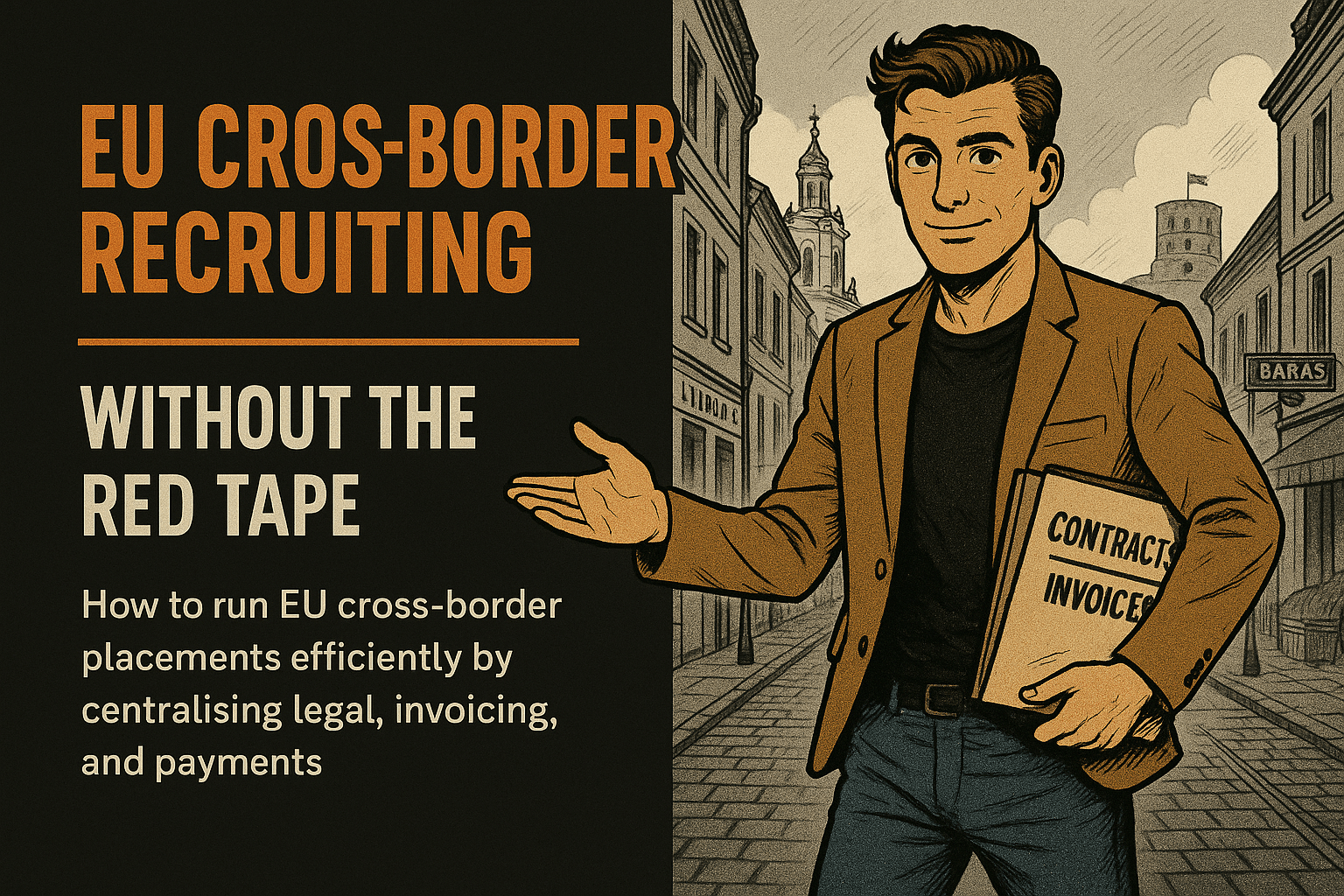
EU cross-border recruiting without the red tape
EU cross-border recruiting looks simple on a map—27 countries, one Single Market—but the moment you place a candidate across a border, paperwork can slow everything down: contracts, invoicing, VAT rules, data-protection notices, even who is allowed to store what. This playbook explains the moving parts of EU cross-border placements and shows how independents can run them without drowning in admin. The headline: when legal, invoicing and payments are centralised and standardised, you remove the red-tape delays and spend more time where you add value—sourcing, screening and closing.
Why cross-border today is an opportunity (not an obstacle)
Talent moves. So do roles. European employers routinely hire in another Member State to access scarce skills, language coverage and cost balance. EU law supports this mobility via the free movement of workers; at the same time, national rules still govern payroll, taxes and employment specifics—hence the practical friction recruiters feel. The answer is not to become a tax lawyer; it’s to work on rails that keep your operations unified and compliant while leaving the country specifics to the parties responsible for them.
In practice, a single operating framework is the difference between losing hours to VAT and contract quirks versus spending those hours building a shortlist. It also helps you live up to GDPR’s principles—lawfulness, purpose limitation and data minimisation—by nudging you toward lean data, consistent notices and a shared workspace where access is controlled by default. That makes your cross-border process both faster and safer. GDPREuropean Data Protection Board
The moving parts of a cross-border EU placement (and how to tame them)
Legal basis & documentation. A cross-border search still starts with the same fundamentals: a role brief, a sourcing plan and notice language that fits recruiting. For most employer-led processes, legitimate interest or contractual necessity—not blanket consent—will be the right footing, backed by clear transparency text that explains purpose and retention. Keep notices simple and tied to the role, and avoid collecting anything you don’t need to decide. TechGDPReploy.com
VAT, invoicing and payments. The EU’s reverse-charge mechanism shifts VAT accounting to the B2B customer for many cross-border services. That’s why a centralised invoicing layer saves independents time and prevents accidental local registrations. Rule of thumb: for services to a VAT-registered business in another Member State, issue an invoice without VAT, reference the customer’s VAT number and “reverse charge,” and the client accounts for VAT at their local rate. When the invoicing rail bakes this in, you reduce mistakes, avoid surprise registrations and get paid on a predictable schedule. European Union
Data protection in practice. Keep personal data minimal and professional. Use a fixed screening rubric and five-bullet summaries instead of free-form notes; store everything in one workspace and apply role-based access. That’s “data protection by design and by default” in plain clothes—and it travels well across borders. European Data Protection Board
Mobility services. At the edges of your remit, public programmes like EURES support employers and workers with advice, placement services and practical guidance in cross-border regions. You don’t need to reinvent those wheels, but it helps to know they exist when clients ask about relocation or cross-border commuting. EURES (EURopean Employment Services)+1
EU cross-border recruiting: the centralised layer for independents
A credible model for independents in Europe combines market freedom with a shared operational backbone:
-
Brand & identity. Send from a professional domain that signals a structured, GDPR-minded operation. A personalised professional @skillseek.eu email makes your very first message look established and reduces “is this legit?” hesitation. SkillSeek
-
Admin handled. Contracts, invoicing, payments and taxes sit in the platform, not on your desk—so you can start right away, without registering a company on day one. SkillSeek
-
Milestone economics. You keep 50% of the placement fee on successful hires, paid in three instalments tied to client-payment milestones (sign-up, placement confirmation, short retention). Progress gets paid and cash flow is smoother than a single end-of-project lump sum. SkillSeek
-
Tools and templates. The Hub gives you video, docs and task management; the Recruiter Success Kit equips you with candidate and client templates, scripts and a step-by-step playbook—so you present like an agency on day two. Use the Templates kit to standardise your packs. SkillSeek
These elements remove red tape not by ignoring it but by making it part of the rails you operate on. When the admin is predictable, you can focus on the high-judgement work: mapping markets, having better conversations and closing.
Aha: the VAT time-sink you never have to learn
If you’ve tried to self-manage cross-border VAT, you know how fast a day disappears. Yes, the reverse-charge principle usually means you don’t add VAT to an invoice for a VAT-registered client in another EU country; the client accounts for it locally. But in practice you still need to validate VAT numbers, reference the rule correctly and include the right invoice fields. When that’s built into your invoicing rail, you enjoy the benefit—no country-by-country VAT registration—without the busywork. European UnionTaxation and Customs Union
Country nuance you should be aware of (without becoming a lawyer)
Cross-border hiring shows up in three common scenarios:
-
Relocation (local employment in the destination country). Labour law and payroll follow the destination; your job is to present candidates who can relocate and to surface constraints early.
-
Remote inside the EU (employee or contractor remains in their home country). Payroll stays local; your model focuses on sourcing/screening and leaving employment setup to the employer or EOR.
-
Posting/secondment (temporary assignment to another Member State). This sits with the employer under the Posted Workers framework—notifications and working-conditions parity apply to the employer, not the recruiter. Your role is to flag the context and keep the process moving. Employment, Social Affairs and Inclusionela.europa.eu
Public information portals (Your Europe, national ministries and the European Labour Authority) make it clear that posting is a specific, regulated case; cross-border commuters follow workplace-country labour law; and equal-treatment rules apply. Those references help you answer “who handles what?” without overstepping. European Union
Side-by-side: ad-hoc cross-border vs centralised rails
| Without a centralised layer | With a centralised layer |
|---|---|
| You draft ad-hoc contracts per client and country. | Standard agreements reflect EU expectations and are ready to use. SkillSeek |
| You guess VAT treatment and formatting per invoice. | Invoicing bakes in reverse charge and triggers milestone payments when the client pays. Taxation and Customs Union |
| You store notes across apps; access control is ad-hoc. | One Hub; role-based access; retention rules are easy to follow. SkillSeekEuropean Data Protection Board |
| Privacy notices vary by mood. | Fixed transparency text tied to recruiting purpose. TechGDPR |
| Payments arrive late and in one chunk. | Three staged payouts aligned to project progress. SkillSeek |
The shape of your week changes as a result. Instead of losing time to legal, VAT and tooling, you spend that time on outreach and interviews—and that’s what clients pay for.
How the model plays with buyers (and why it speeds decisions)
Clients want two things: risk managed and interviews quickly. The operating system above lets you deliver both:
-
Risk managed: the sender domain signals a professional channel; contracts and privacy notices aren’t improvised; invoices match expectations in their country.
-
Interviews quickly: one-page profiles, pre-booked slots and a recruiter who doesn’t get stuck in admin.
Add a light AI copilot—ChatGPT or similar—for first-pass outreach and five-bullet summaries, and the front of the funnel compresses further. The point isn’t novelty; it’s repeatability, across borders.
A 48-hour cross-border sprint (yes, it holds up EU-wide)
Day 1, morning: Send three segment-specific outreaches (passive / active / referral) from your branded address, each under 100 words with a single yes/no ask and two 10-minute screen options.
Day 1, afternoon: Run 4–6 quick screens using your rubric. Document five bullets only; no free-form “notes.”
Day 2, morning: Package a three-candidate shortlist in your standard profile layout.
Day 2, afternoon: Offer two pre-agreed client slots; lock the first interview.
Nothing in that flow changes if your candidate is in Lisbon and your client is in Leipzig—because the rails are the same. For readers who want to operate at scale, look for EU-wide recruiting support so you don’t rebuild the machine per country.
Where the money lands (and why milestones matter)
Here’s familiar math using a common EU fee of ~20% of annual salary. On a €60,000 role, the client’s fee is €12,000. Your share at 50% is €6,000—paid across three milestones (20% at sign-up, 30% at placement confirmation, 50% after a short retention period). That aligns incentives with quality and protects cash flow during multi-country searches. Keep this visible in your pipeline: progress gets paid. SkillSeek
The invoice anatomy (so clients feel no friction)
When a German client hires you for a cross-border search, they expect an invoice that looks familiar. For B2B services where reverse charge applies, include: issue date, sequential number, supplier and customer details, the customer’s VAT number, description of services, net amount, and the explicit phrase “reverse charge.” This makes it clear that the client will self-account for VAT at their local rate and keeps the transaction VAT-neutral. A centralised rail that adds these elements automatically prevents back-and-forth with finance teams and shortens time-to-invoice. Taxation and Customs UnionStripe
Your buyer talk track (copy this)
“We run EU-wide searches on standard rails. You’ll get one-page profiles and two interview slots within 48 hours. We invoice on milestones and use EU-standard reverse-charge invoicing, so your finance team sees familiar formats. Data stays lean and purpose-tied; we store only what’s needed to decide. If posting or relocation questions come up, we signpost official EU resources and keep your process moving.”
That language pre-answers the three silent objections in cross-border hiring—is this compliant, how do we pay you, will this be slow?—and it reframes you as a low-risk operator.
FAQs for independent recruiters (EU focus)
Do I need to register a company before I start?
You can start sourcing and placing on a platform where invoicing and taxes are handled, including milestone payouts after client payment. That lets you operate before standing up a full entity. SkillSeek
What happens if a placement crosses borders mid-process?
Nothing breaks. Your privacy notices and formats don’t change; you may adjust scheduling and relocation notes, but the rails are identical.
How do I avoid GDPR mistakes across countries?
Stick to role-relevant data, give clear notice, and set retention tied to the lifecycle of the process. If in doubt, keep less and delete sooner. The principles—lawful basis, purpose limitation, data minimisation—don’t change with borders. GDPRTechGDPR
Do I have to understand posted-worker rules?
You should know what posting is and that it’s the employer’s responsibility. Your value is speed and signal: shortlists, structured screens and clear constraints. When asked, point to official guidance and keep delivering the recruiting work. Employment, Social Affairs and Inclusion
What if I want to grow from side-gig to practice?
That’s where milestone economics and reusable templates help. Because you keep 50% fee share, each additional placement compounds income; and because tooling and templates are centralised, onboarding collaborators is straightforward. SkillSeek
A small EU-aware example set (cash flow)
-
Salary €60,000 (NL) → client fee ~€12,000 → your share €6,000 across three payouts (20% / 30% / 50%).
-
Salary €45,000 (PT) → client fee ~€9,000 → your share €4,500 on the same schedule.
-
Salary €75,000 (DE) → client fee ~€15,000 → your share €7,500; second payout often coincides with contract signature.
This milestone shape supports longer cross-border searches without starving your cash flow. SkillSeek
When to add a light AI layer (and when not to)
Use an AI copilot to draft first-pass outreach, summarise screens into five bullets and suggest interview questions tailored to the role. Skip AI for anything that touches legal, tax or privacy wording—those should follow the standard templates you control. ChatGPT, used this way, saves minutes per candidate without changing your process.
EU-wide examples you can copy tomorrow
-
PT → DE (engineering). Three maintenance engineers with TPM achievements and German-working-language comfort; screen on tooling and travel %.
-
BE/LU → FR (fintech). Compliance lead with PSD2/AML depth; present two interview slots aligned to FR working hours.
-
PL/CZ → NL (manufacturing). Welders with certifications and safety record bullets; add a note on mobility/rotations.
Pair every pack with a literal subject line (“10-min fit check for [role]”) and a yes/no ask. The combination of standardised format and pre-booked slots shortens your time-to-interview across borders because it reduces decision friction, not just time zones.
Bring it together
Cross-border placements don’t have to equal red tape. If you unify the operating layer—brand identity, agreements, invoicing, payments and privacy hygiene—you can run the same 48-hour path from outreach to interview in Lisbon, Łódź, Leuven or Lyon. Keep data lean, invoices correct and calendars controlled. Present like an agency from day two. And remember: the economics reward momentum—because each milestone moves money, and each shortlist is a step closer to your next retained client. If you want the shortcut: join as a freelance recruiter and plug into an EU-wide network without rebuilding the back office.
