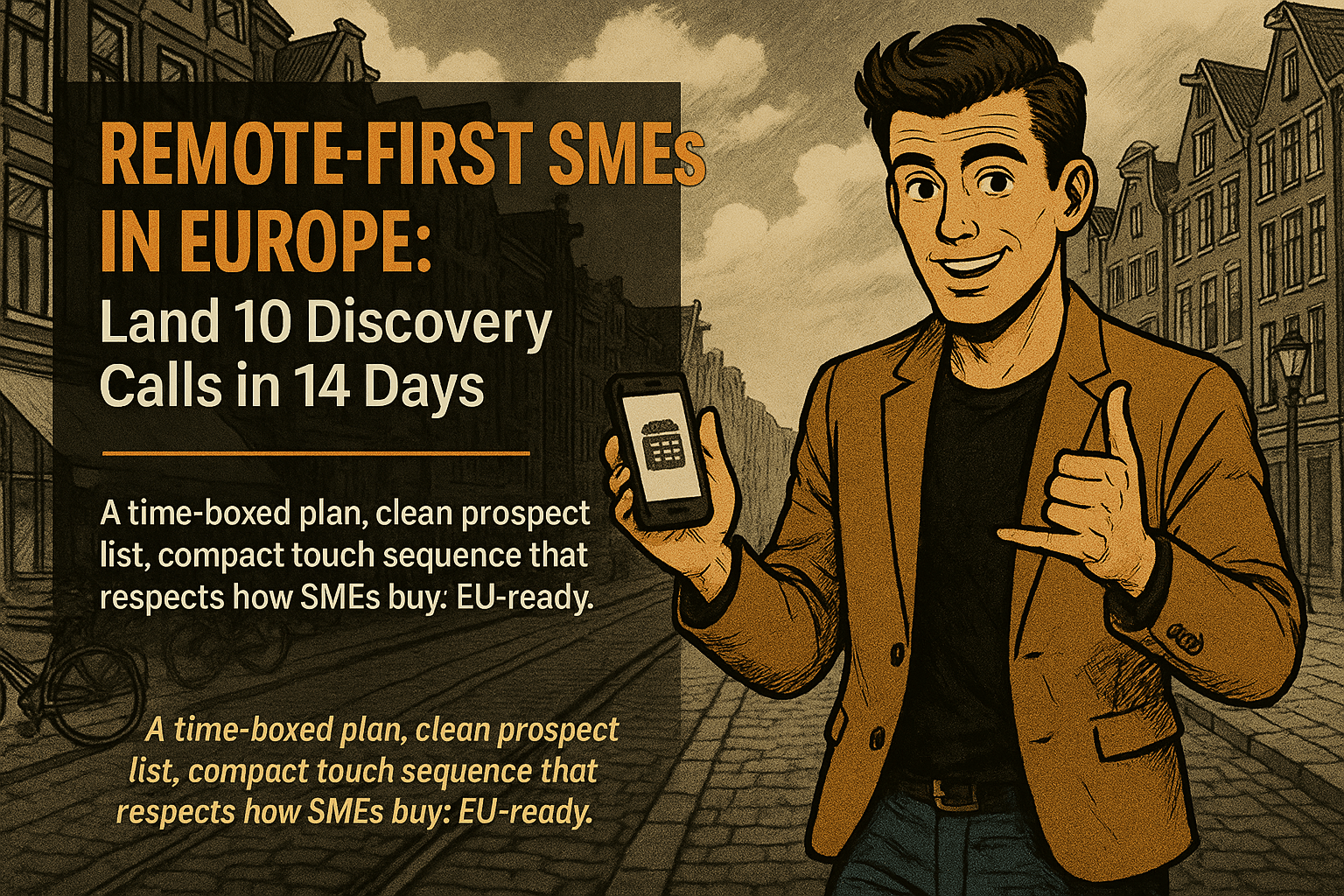
Remote-First SMEs in Europe: Land 10 Discovery Calls in 14 Days
Remote-first SMEs are the most responsive market for fast, credible outreach in Europe right now. They run lean teams, make decisions quickly, and hire across borders when the skills are right. If your goal is to book discovery calls at pace, you don’t need a big ad budget—you need a time-boxed plan, a clean prospect list, and a compact touch sequence that respects how small and midsize businesses actually evaluate recruiting partners. This guide delivers that plan step-by-step, tuned for EU reality.
Why remote-friendly SMEs are a sweet spot in Europe
SMEs are the backbone of Europe—99% of EU companies—European Parliament, and many embrace flexible or remote setups because they prioritise speed and cost control. For recruiters, that means shorter cycles from first contact to first meeting and more pragmatic evaluations of fit. In 2024, a majority of EU enterprises enabled online meetings and remote access to company systems; over half conducted online meetings and more than four-fifths gave staff remote email access—evidence that digital collaboration is standard operating practice across the bloc. In Eurostat’s 2024 enterprise IT survey, 52.9% of EU enterprises conducted online meetings; 81.0% provided remote access to email; and 69.0% provided remote access to documents—so a discovery call over video at short notice is a normal ask for SMEs. European Commission
Two more signals reinforce the fit. First, remote and hybrid options remain resilient among SMEs despite high-profile “return to office” headlines. Second, official data continue to track meaningful remote-work shares across advanced European economies, with the UK, Nordics, and the Netherlands especially remote-tolerant. Translation: the infrastructure and culture for remote conversations are in place—your job is to target well and sequence outreach. Cafloueuronews
The target: book 10 discovery calls in 14 days
You’ll achieve this with a list of 400–600 high-relevance SME prospects and a four-touch sequence delivered over ten working days. With typical cold-email reply rates around 5–7% (and LinkedIn DM replies in a similar single-digit band), and a 30–40% conversion from positive reply to booked call when you make scheduling frictionless, the math works: ~30–40 replies → 10–14 booked calls. Layer in light phone follow-ups on Day 7 and Day 12 to scoop near-fits and you’ll comfortably hit the goal even with conservative reply rates and a few no-shows. For planning, expect most meetings to land inside European core hours (09:00–17:00 CET). Saleshandybelkins.io
Primary mechanics you’ll rely on
-
Signals over slogans. Every message must name one business outcome (not a service category) and end with a binary ask.
-
Calendar control. Offer two concrete time slots in CET and include the video link in the invite.
-
Template discipline. Keep all artefacts to one page and five bullets. Decision-makers read on phones.
The Prospect List Template (copy this structure)
Build the sheet with these columns. Keep it lean so you can enrich and execute quickly.
-
Company | Country | Headcount (range) | Hiring trigger (funding, expansion, new facility, product launch) | Remote posture (remote-first / hybrid / on-site) | Role focus (your niche) | Decision contact (Head of Ops/HR/Eng, founder) | Email | LinkedIn | Notes (one line: business outcome you’ll reference) | Status (T1 / T2 / No fit) | Last touch | Reply? (Y/N) | Call booked? (Y/N)
Sources to build it
-
Public signals: company blogs, newsroom pages, job boards, LinkedIn updates.
-
EU registers and industry lists; niche Slack/Discord communities for tech and operations.
-
“Remote” filters on job boards and hand-built searches that pair your niche with SME hotspots (Benelux, DACH, Nordics, Baltics).
Pro-tip: colour-code by country/time-zone band (CET-1, CET, CET+1). It streamlines your calling windows.
The 14-day plan (time-boxed)
You will run a simple cadence: build (Days 1–2), launch (Days 3–4), follow through (Days 5–12), close (Days 13–14). Below is the day-by-day.
Days 1–2: Build and segment your list (6–8 hours total)
-
Pull 600 companies; trim to 450 that match your niche and remote posture.
-
Identify one decision contact per company—aim for founders, HR/People leads, or functional heads.
-
Write a one-line business outcome for each (from public signals).
-
Tag T1 (clear pain + recent signal) vs T2 (weaker signal). You’ll contact T1 first.
-
Draft your two scheduling slots for each of the next two weeks (e.g., Thu 10:30 CET, Fri 14:00 CET).
Internal lift: send from a professional domain and include your brand one-pager in a standard format. A personalised professional @skillseek.eu email and ready-made assets raise reply rates because they look familiar and credible to SMEs. Link your signature to your Candidate Profile Templates so prospects can see, at a glance, how you present talent. SkillSeek
Days 3–4: Touch #1 (email or LinkedIn DM)
Use a literal subject line and a 90-word note. Name one business outcome. Ask one yes/no. Offer two time slots.
Example email (90 words)
Subject: 10-min fit check: reduce onboarding time by 30%?
Quick context: I help EU SMEs cut hiring friction for [role focus], so new hires hit output faster. For [COMPANY], the relevant outcome seems to be [your one-line business outcome] based on [source]. If a 10-minute fit check is useful, I can place you into Thu 10:30 CET or Fri 14:00 CET this week. If not you, who leads [function] today? I’ll send a one-pager before the call either way.
—[Name], [title], [brand domain]
If DM: Use the same structure; skip the subject and keep it < 70 words.
Pro-tip: build your sender reputation on a professional domain before launch; warm up with small sends and avoid images/attachments on Touch #1.
Day 5: Touch #2 (value bump)
Send a new email/DM with one fresh piece of value: a short market insight (e.g., “median notice is 30–60 days in your niche”), a case bullet, or a comparison of candidate supply in two EU locations. Restate the same two time slots (or the next two) and keep the ask binary. Do not attach decks; link to a one-page profile or proposal if needed.
Internal lift: reuse Candidate Profile Templates and a one-page Client Proposal so your pack reads the same every time, and your contact can scan on a phone in one minute. Use the Templates kit once to lock the format.
Day 7: Light phone follow-ups (Touch #3)
Call 60–80 of your T1s. Your 30-second opener:
“Hi [Name]—it’s [You]. I sent a short note re: reducing [business outcome] for [Company]. Two quick options: a 10-minute fit check Thu 10:30 CET or Fri 14:00 CET. Does either work? If not, who’s best to own this?”
Expect 2–3 attempts to connect; be ready to leave one 20-second voicemail with the same binary ask. Cold-calling studies show conversation rates jump when you make several attempts in a tight window, so batch your dials. Cognism
Day 10: Touch #4 (final nudge)
Short “bump” email/DM (≤ 35 words) that adds one new piece of value and re-offers two slots next week. Close the loop by saying you’ll pause outreach after this unless asked to continue.
Days 11–12: Consolidate and reschedule
Fill any gaps with T2s or fresh T1s. Maintain the same messaging discipline and slot offers. Confirm calendar invites for every “yes” within 15 minutes.
Days 13–14: Debrief and book the last 2–3 calls
Send one round of personalised nudges to warm maybes. Offer flexible windows (early/late CET) to catch UK/IE and EE/FI. Wrap with a short summary of why a 10-minute call now is smart (hiring calendar planning, comparing two EU talent pools, etc.).
Copy-ready messages and prompts
Use these three paste-ready prompts to keep speed high:
-
“From the role and company notes below, draft a 90-word first email that names one business outcome, includes two CET time slots, and asks for a simple yes/no. No superlatives; no assumptions.”
-
“Summarise this call in five bullets with only verifiable facts (scope, tools, context, outcomes, timing).”
-
“Write a 35-word bump that adds one concrete value point (market metric or candidate availability) and ends with two time slots.”
Benchmarks and the math behind 10 calls
Cold outreach is noisy, so you’ll rely on discipline rather than volume. Multiple 2024–2025 studies peg cold email reply rates around 5–7%; LinkedIn outreach sits in the same single-digit range. Phone contact rates increase meaningfully when you make 2–3 attempts per prospect. If you start with 450 prospects (T1/T2) and execute all four touches:
-
Email/DM replies (5–7%): ~23–32 positive/neutral replies.
-
Phone lifts (+8–12 extra conversations across two dial days): ~6–10 more live chats.
-
Conversion to booked calls (30–40% when you pre-offer slots): 10–14 calls.
If replies lag, expand T2s by 150 and repeat Touch #1 and #2 in Days 9–12. The plan is elastic by design. Saleshandybelkins.io+1Cognism
What to standardise (and what to customise)
Standardise
-
Email/DM skeletons (intro → outcome → yes/no ask → two slots).
-
One-page profile/proposal formats (headline + five bullets + availability).
-
Screening rubric for discovery calls (6 questions; five-bullet summary).
-
Calendar protocol (always propose two CET slots with offsets).
Customise
-
The single business outcome per company.
-
The specific EU talent pool comparison you reference.
-
Which stakeholder you target first (founder vs functional head vs people lead).
EU-specific notes you must respect
-
Privacy & data minimisation. Keep notes minimal, store centrally, and avoid sensitive personal data. The GDPR principles—purpose limitation and data minimisation—travel with you across borders.
-
VAT and invoicing. For cross-border B2B services to VAT-registered clients, reverse-charge invoicing is normal—keep finance friction low by using standard fields and phrasing on invoices.
-
Time-zone etiquette. Default to CET offers, add one offset when targeting UK/IE (CET-1) or Baltics/Finland (CET+1).
Operational lift: when invoicing and taxes are handled centrally and you have ready-to-use legal rails, discovery calls progress cleanly into paid work instead of stalling on paperwork. Anchor this in your outreach: “We operate on standard EU rails; your finance team will see familiar invoices and milestone terms.” SkillSeek
The assets that make you look “ready on day two”
-
A professional @skillseek.eu email in your signature for credibility on first contact.
-
A one-page Client Proposal and a one-page Candidate Profile format that buyers can scan on a phone.
-
A “Discovery Call” note template (six questions, five-bullet summary).
-
A short “What we do in 10 minutes” PDF you can link on Touch #2. SkillSeek
EU-wide credibility: being able to say you recruit across borders with EU-wide recruiting support, a transparent 50% fee share, and milestone-based payments removes perceived risk for SMEs and speeds the “yes.” SkillSeek+1
The 7-touch sequence variant (if you have the bandwidth)
If you want to push beyond the four core touches, use this expansion:
-
Email/DM #1 (Day 3)
-
LinkedIn view + connect (Day 3 or 4)
-
Email/DM #2 (Day 5)
-
Phone dials (Day 7)
-
Email/DM #3 (Day 10)
-
Comment on their latest post (Day 10–11)
-
Final email with a calendar link (Day 12)
Keep tone factual and utilitarian throughout.
What to measure (dashboard)
-
Prospects loaded (T1/T2), emails sent, DMs sent, calls made.
-
Reply rate by channel and by country.
-
Booked calls (daily cumulative).
-
No-shows (keep under 10% by sending a same-day reminder).
-
Conversion from discovery → proposal.
-
Win rate and time-to-hire for SME roles.
FAQs from SME buyers you’ll meet on these calls
“How fast can you show candidates?”
Often within 48 hours for a first shortlist when we pre-book two interview slots and present one-page profiles.
“Are you set up to handle cross-border?”
Yes—standard legal terms, reverse-charge invoicing, and GDPR-minded operations are baked in, so projects move without administrative drama. SkillSeek
“What’s the risk if we’re not hiring right away?”
We do a short discovery, map the relevant talent pools in two EU locations, and you decide when to green-light interviews.
Bring it together
A two-week goal of ten discovery calls with remote-friendly SMEs in Europe is entirely realistic when you enforce list quality, message discipline, and calendar control. Use a lean prospect template, run the four-touch sequence on time, and make it obvious how to say “yes.” With a professional identity, standardised templates, and payment/legal rails already in place, you turn interest into meetings—and meetings into revenue—without drowning in admin.
